

How to Use a Brix Refractometer: Step-by-Step Guide & Tips
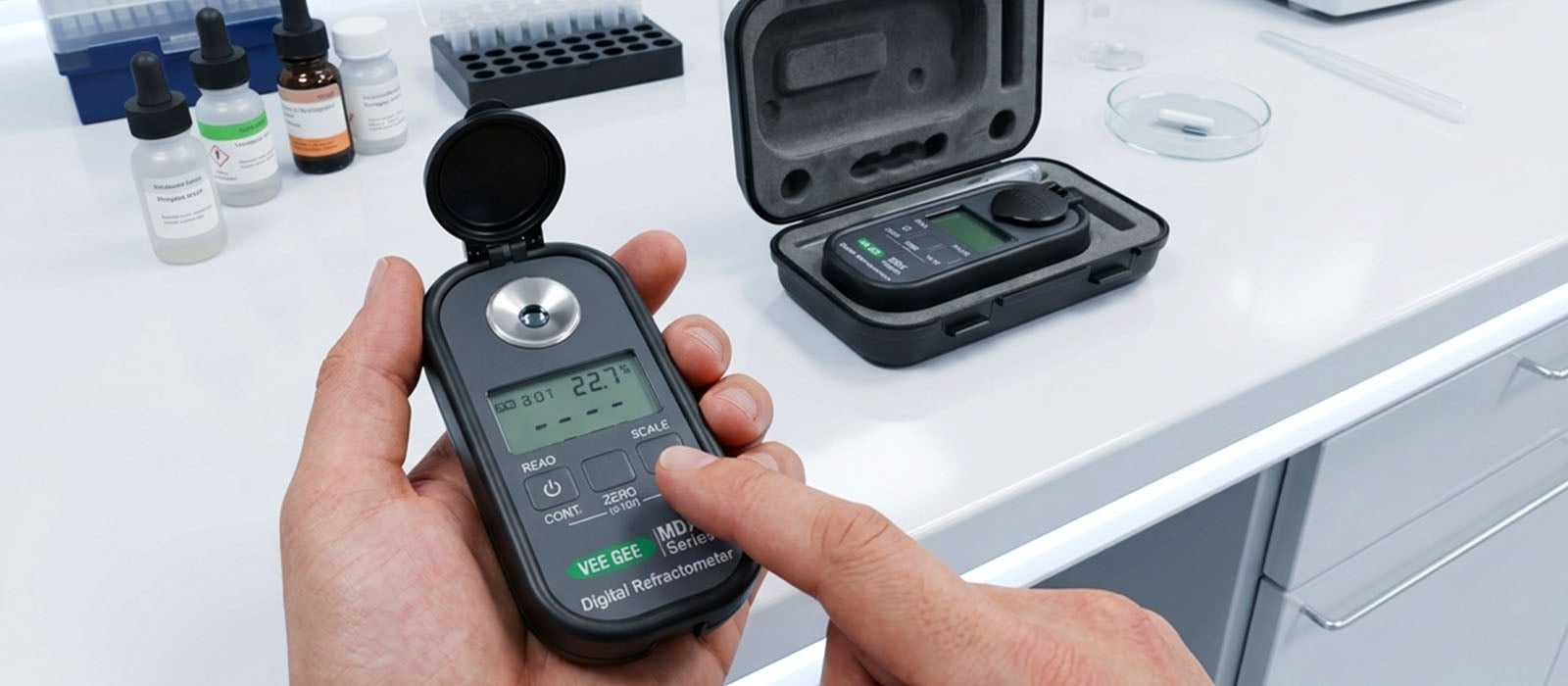
Struggling with inconsistent sugar or solid readings? Learn how Brix refractometers work, how to properly use them, and how to get reliable results.
If you've ever squeezed a grape between your fingers wondering whether it's ready to pick, or pulled a sample from a batch of juice concentrate before it ships, you've probably wished for a faster way to know exactly how much sugar or dissolved solid content is in that liquid. That's where a Brix refractometer comes in.
Portable Brix refractometers are a staple in food and beverage production, agriculture, brewing, and laboratory settings because they're so easy to use inside and outside the lab. This guide covers what a Brix refractometer measures, where it's commonly used, the two main types you'll run into, and how to get consistent, reliable readings.
What Is a Brix Refractometer?
A Brix refractometer is a small, simple tool that delivers a concentration reading in seconds, using nothing more than a drop or two of the sample. It measures how light bends, or refracts, as it passes through a liquid sample.
This measurement is expressed in degrees Brix (°Bx), wherein:
-
Higher Brix = more concentrated product (e.g. tomato paste)
-
Lower Brix = less concentrated product (e.g. crushed tomatoes or tomato juice)
In a pure sucrose-water solution, Brix is equal to about one gram of sugar per 100 grams of solution. However, real-world samples contain other dissolved substances that also bend light. This explains why a Brix reading is best treated as a snapshot of a sample's total soluble solids rather than a precise sugar count.
Common Applications for Brix Refractometers
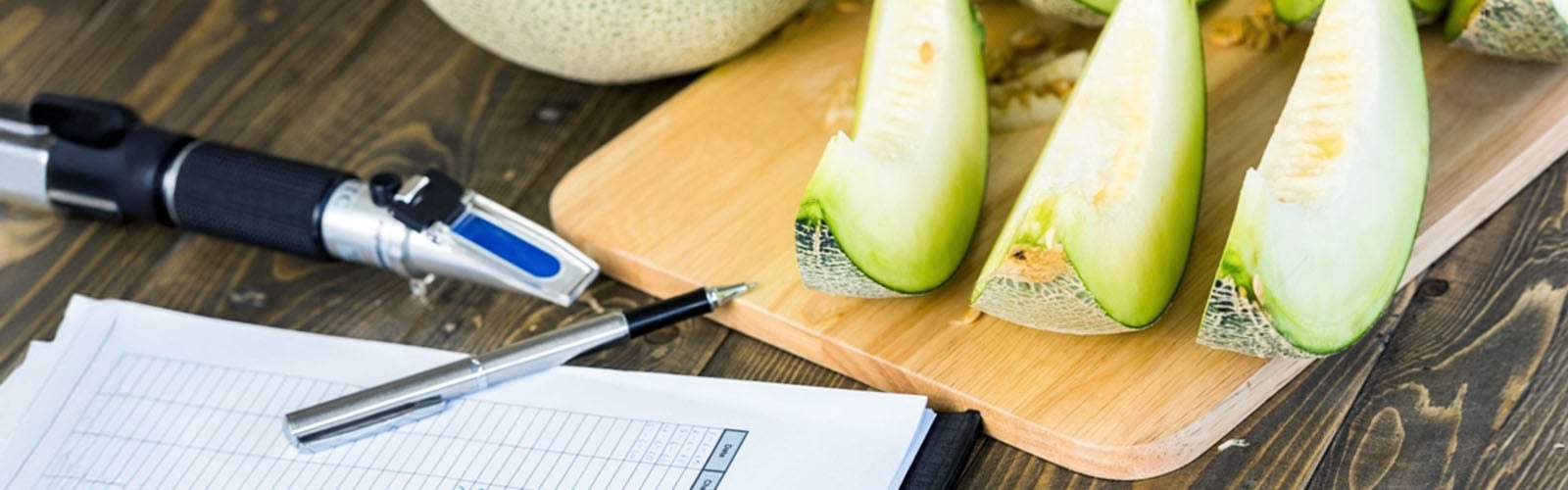
One of the advantages of a portable refractometer is its versatility. Brix measurements can support several different applications
Food and Beverage Quality Control
Brix refractometers are frequently used to monitor soluble solids concentration in products such as:
-
Fruit juices
-
Soft drinks
-
Syrups
-
Sauces
-
Jams and preserves
-
Honey
-
Other sugar-containing foods and beverages
Measuring Brix can help manufacturers evaluate batch consistency and monitor concentration during processing.
Fruit and Agricultural Testing
Because sugar and soluble solids levels can change as fruits mature, refractometers can be used to evaluate fruit juice samples during agricultural and post-harvest testing.
Brix measurements can provide another data point when assessing maturity, sweetness, and consistency between samples.
Brewing and Fermentation
Brewers, winemakers, and other fermentation operations can use Brix measurements to evaluate sugar-containing solutions during production.
When fermentation has begun, however, alcohol affects refractive index. Appropriate correction methods may therefore be required when interpreting refractometer readings from fermented samples.
Laboratory and Process Testing
Portable refractometers can also be used for general concentration checks and quality-control measurements where the refractive characteristics of a solution correlate with concentration.
Types of Portable Brix Refractometers
Portable Brix refractometers generally fall into two camps, and which one suits you often comes down to how you like to work.
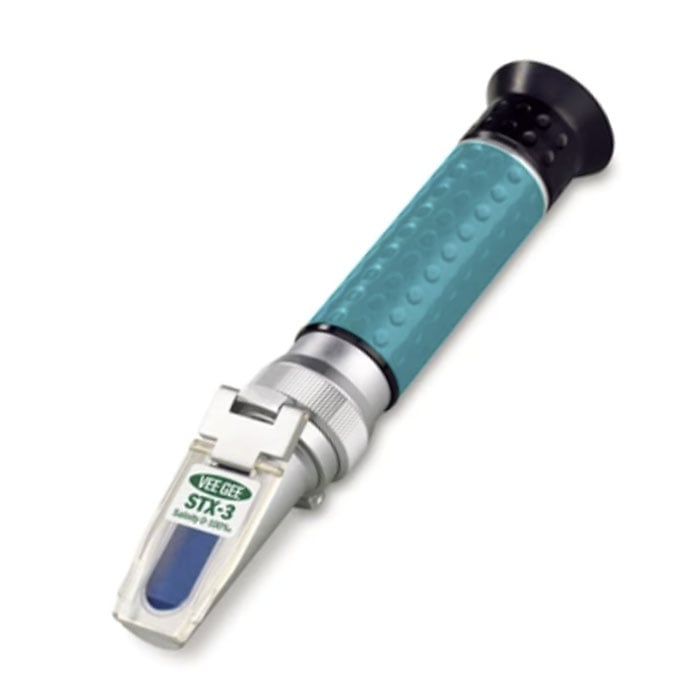
Handheld Analog Refractometers
Analog refractometers use a prism, daylight plate, eyepiece, and internal scale. After the sample is placed on the prism, the user holds the instrument toward a light source and looks through the eyepiece. The Brix value is identified at the boundary between the light and dark areas of the scale.
A handheld refractometer is compact, requires no electronic display, and is well suited for quick measurements in the laboratory or field. The Lab Depot's VEE GEE Scientific handheld Brix refractometers, for example, are available in several Brix ranges to accommodate different sample concentrations.
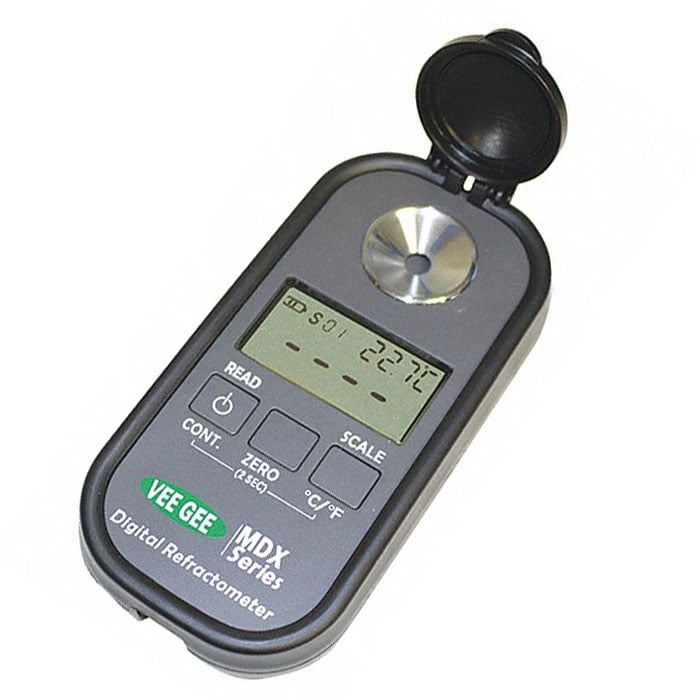
Portable Digital Refractometers
Digital refractometers simplify the reading process by electronically measuring refractive index and displaying the result on a screen. Instead of interpreting a scale through an eyepiece, the operator places the sample into the measurement area and initiates the measurement.
Depending on the model, digital instruments, such as those from Milwaukee Instruments, may also provide automatic temperature compensation (ATC), multiple measurement scales, and additional refractive index capabilities.
How to Use a Portable Brix Refractometer
Exact steps vary a bit by model, but the general process for a hand held refractometer looks like this.
-
Clean the prism. Start with a prism that's completely clean and dry. Leftover residue from a previous sample changes the refractive index right where you're about to measure, so wipe it down with a soft, lint-free cloth before doing anything else.
-
Calibrate the refractometer. Put a few drops of distilled water on the prism and close the daylight plate. Hold it up to a light source and check where the boundary line falls, which should land right on zero. If it's off, adjust it following your manufacturer's calibration steps. (Digital refractometers usually just have a calibration button; check your instrument's manual for the exact process.)
-
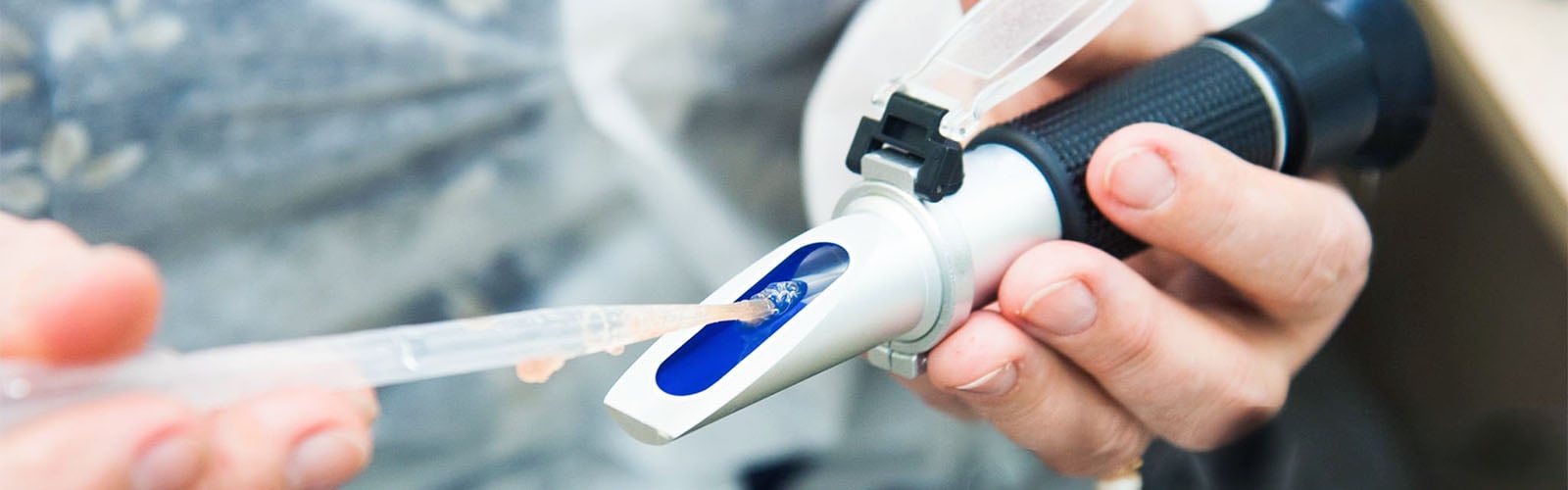
Apply the sample. Clean and dry the prism once more, then use a pipette or dropper to place a few drops of your sample onto it. You don't need much — just enough to cover the measurement area evenly, with no dry spots or trapped air.
-
Point the refractometer toward a light source. With an analog unit, hold it up toward a window, lamp, or other suitable light and look through the eyepiece. Adjust the focus until the scale comes in clearly. You should see two distinct fields, light and dark, meeting at a boundary line.
-
Read the Brix value. Find where that boundary line crosses the scale — that's your reading. If it lands at 12, for example, your sample measures about 12° Brix. Digital refractometers skip this step entirely and just display the number.
-
Clean the refractometer. Once you've got your reading, wipe the prism down again. Dried sample residue is the enemy of both accuracy and instrument longevity, so don't skip this step even if you're about to run another test right away.
Choosing the Right Portable Brix Refractometer
Not every Brix refractometer suits every job. A few things worth weighing before you buy:
-
Measurement range. A low-Brix beverage and a thick, high-sugar syrup call for different ranges. Check that your instrument covers the concentrations you'll actually be testing.
-
Accuracy and resolution. How precise does your process or QC procedure need to be? Higher resolution matters more in some applications than others.
-
Analog vs. digital operation. Analog units are simple, rugged, and don't rely on batteries. Digital units take the guesswork out of reading a scale and often add extra features. Neither is universally better, as it all depends on your workflow.
-
Temperature compensation. If you're testing in variable conditions, whether that's a warm production floor or a field in midsummer, ATC can save you from chasing inconsistent readings.
-
Application-specific scales. Some refractometers go beyond Brix and offer refractive index, salinity, specific gravity, or scales built for particular products.
Tips for Getting More Consistent Brix Measurements
A refractometer is a simple tool, but technique still matters. A few habits that go a long way:
-
Keep the prism clean. Even a thin film of residue can skew a reading.
-
Calibrate regularly. Don't assume yesterday's calibration still holds. Check it against your manufacturer's recommended schedule.
-
Use enough sample to cover the prism. A patchy sample layer makes the boundary line hard to read accurately.
-
Avoid bubbles. Trapped air between the sample and prism interferes with the measurement.
-
Let temperature stabilize when it matters. A big gap between sample and instrument temperature can throw off your reading, even with ATC.
-
Use the right Brix range for your sample. A refractometer built for a different concentration range won't give you a reliable number.
-
Repeat the measurement. If a reading looks off, take a second or third one. It's the easiest way to catch a fluke caused by technique or sample prep.
Frequently Asked Questions
What is a refractometer?
A refractometer is a compact, easy-to-use instrument that uses the principle of light refraction to measure the concentration of dissolved solids or liquid solutions with just a drop or two of a sample.
How does a refractometer work?
When light passes through air into a liquid sample, it bends or refracts, and a refractometer measures that angle of deflection. The degree to which the light bends depends entirely on the density of dissolved solids in that sample.
What does a Brix refractometer measure?
It measures a liquid's refractive index and converts that into a Brix value. In a pure sucrose solution, that value corresponds directly to sugar concentration by weight. In more complex liquids, other dissolved solids contribute to the reading too.
How many drops are needed for a refractometer?
Just a few — usually enough to cover the prism or measurement window. Exact volume depends on the model, so it's worth checking your instrument's manual.
Should you calibrate a Brix refractometer before use?
Yes. Regular calibration, often using distilled water for a zero reading, keeps your measurements reliable. The calibration process depends on the model you're using.
What is the difference between an analog and digital Brix refractometer?
An analog refractometer requires you to look through an eyepiece and read where the boundary line falls on a scale. A digital refractometer measures the sample electronically and shows you the result on a screen, no interpretation needed.
What is automatic temperature compensation on a refractometer?
Automatic temperature compensation, or ATC, adjusts for the fact that temperature affects refractive index. It helps keep readings consistent even when your sample or environment isn't at a fixed temperature, within the instrument's specified range.
We stock a solid selection of digital, handheld, and ABBE refractometers from manufacturers you can count on. Need a hand picking the right model for your setup? Connect with The Lab Depot team at 1-800-733-2522, email, or chat with us on our website.