The United States Pharmacopeia (USP) is an internationally recognized, non-government organization dedicated to ensuring safe, quality medicines are available to patients worldwide. USP is grounded in extensive scientific research and the contributions of medical and pharmaceutical experts to develop industry-recognized quality standards that protect public health.
What is USP Chapter 41: Balances?
USP 41 is the chapter titled “Balances” and is a mandatory requirement for ensuring the repeatability and accuracy of balances used in pharmaceutical processes. When materials must be “accurately weighed,” this standard chapter must be followed.
USP Chapter 41 was revised in December 2013, changing its title from “Weights and Balances” to “Balances.” The revision emphasizes the focus on the major area of application and the transition from terms like “analytical balance minimum weight” and “USP minimum weight” to “repeatability” and “accuracy” to help determine the operating range of a balance.
Mandatory USP 41 Requirements
USP 41 aims to ensure weighing accuracy that reflects current weighing methods. It has two mandatory critical components:
Repeatability
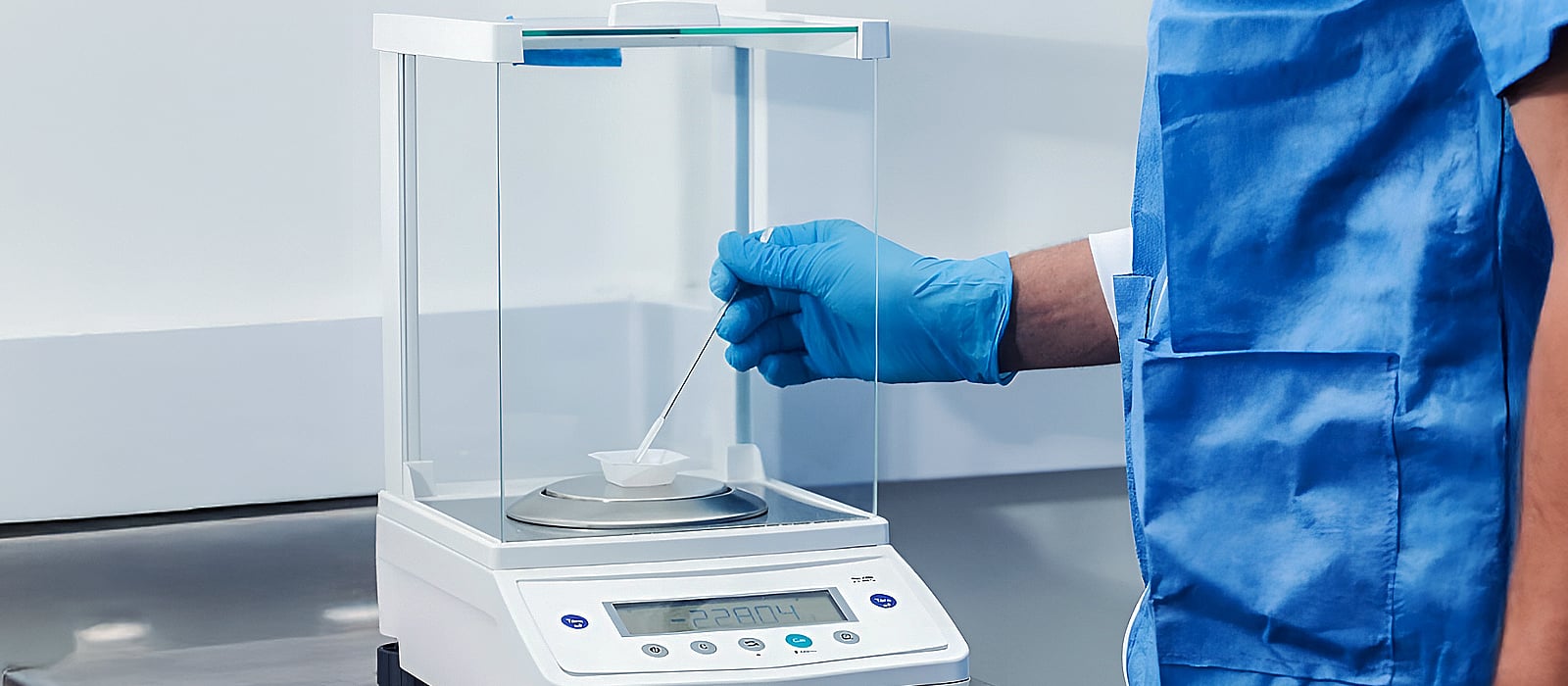
The USP 41 standard does not dictate the minimum weight that can be used but rather how the user can determine the operating range of the balance. The balance’s operating range is determined from the repeatability of the lab balance at a nominal value. This is a requirement that the user can perform during balance calibration.
During calibration, the weight used will be the maximum weight for that balance. This maximum weight will be used to perform 10 replicate weighings to calculate the standard deviation. The standard deviation is then used in a series of calculations defined in USP 41 to establish the starting point of the balance’s operating range.
Accuracy
Accuracy defines the test weight that can be used to test balances, such as those from top manufacturers like OHAUS. The weight must be within 5% to 100% of the balance’s capacity, and the test weight’s tolerance must be 0.10% of the nominal value.
Additionally, the measurement uncertainty must not exceed 1/3 of the test weight’s tolerance as defined by the weight class. Therefore, all test weights must have a traceable calibration report that lists the correction and measurement uncertainty values.
What is USP Chapter 1251: Weighing on an Analytical Balance?
USP 1251 is the chapter titled “Weighing on an Analytical Balance.” It is a guideline for working with analytical balances and includes information on balance environment, calibration, balance uncertainties, weighing material recommendations, and safety procedures. When followed, the practices in this recommended chapter eliminate weighing process errors.
USP 41 vs. USP 1251
|
USP 41 |
USP 1251 |
| Title |
Balances |
Weighing on an Analytical Balance |
| Chapter Type |
Official (Mandatory) |
Informational (Advisory/Guidance) |
| Enforceability |
Enforceable by regulatory bodies |
Not enforceable; intended to provide best practices |
| Focus |
Accuracy and performance verification of balances |
Practical guidance for proper weighing techniques and procedures |
| Test Requirements |
Repeatability and accuracy tests must be met |
Explains additional tests but not required |
| Calibration |
Balance must be calibrated and verified before use |
Recommends calibration frequency and best practices |
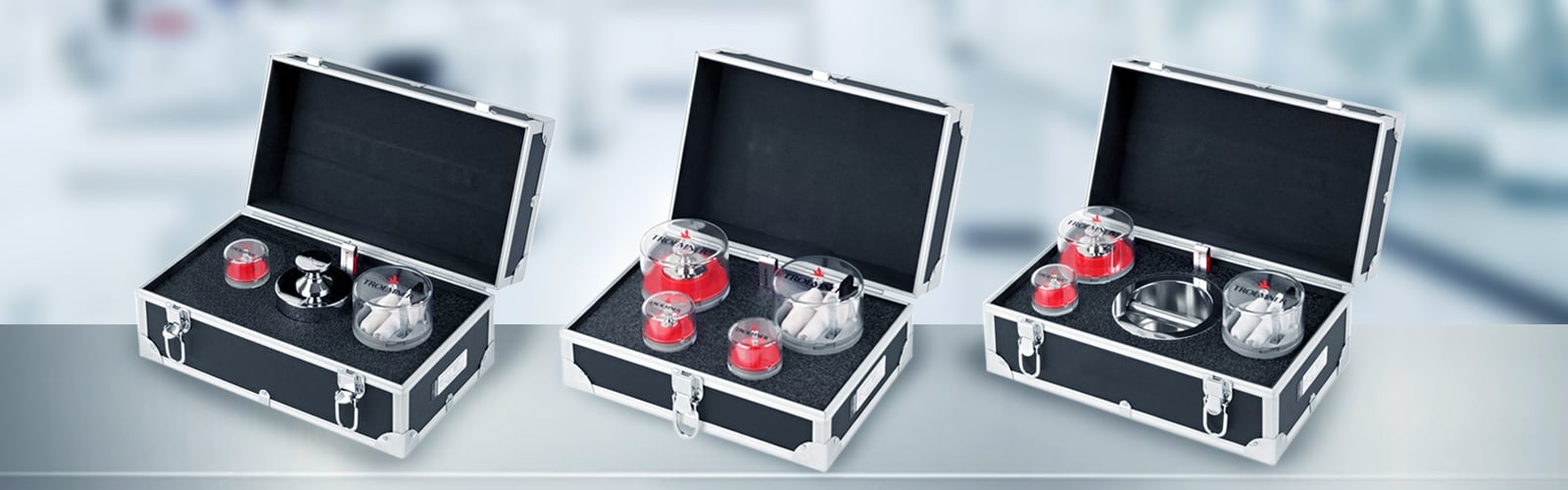
Troemner Cal-Pak Calibration Kits for Laboratory Balances
Troemner recommends selecting a Cal-Pak calibration weight set with a more precise weight class tolerance than the values calculated according to USP 41. Selecting calibration weights with a tighter weight class tolerance may lower the risk in the weighing process. Consider if the calibration weights used failed their periodic calibration; an investigation may prove the process limits were exceeded. Choosing a Cal-Pak with a more precise weight class tolerance allows the drift of the calibration weights between calibration cycles.
If your process limits are exceeded, you may face a product recall due to this out-of-tolerance condition. Weights with a tighter weight class tolerance will reduce the risk of an out-of-tolerance circumstance occurring.
Why Choose Troemner Cal-Pak Calibration Kits?
- Designed to meet USP 41 requirements for calibration and repeatability.
- Compatible with all balance manufacturers’ makes and models.
- Available in two configurations:
- The manufacturer’s recommended calibration weight
- 10% of the calibration weight
- Repeatability test weight
- The recommended calibration weight
- Repeatability test weight
- Selection can be tailored based on your mass measurement assurance program and required accuracy class.
- Weights are precision-manufactured for reliable and consistent results.
- Each component is linked with a unique serial number.
- Weights are traceable to an ISO/IEC 17025 Accredited Calibration Certificate.
- Traceability to the international kilogram standard with uncertainties exceeding USP requirements.
- Includes a master carrying case for secure storage and identification.
Get all these features when you order the OHAUS Cal-Pak ASTM Class 1 Calibration Weight Sets.
Semi-Micro Balance Calibration Kits
Class 1 with an Accredited Certificate
| Capacity (g) |
Readability (g) |
Resolution (d) |
Product SKU |
Number of Weights |
Nominal Value of Weights |
| 82 g |
0.00001 g |
8 200 000 d |
30391795 |
3 |
50 g, 5 g, 2 g |
| 120 g |
0.00001 g |
12 000 000 d |
80859548 |
2 |
100 g, 5 g |
| 220 g |
0.00001 g |
22 000 000 d |
80859549 |
2 |
200 g, 10 g |
Analytical Balance Calibration Kits
Class 1 with an Accredited Certificate
| Capacity (g) |
Readability (g) |
Resolution (d) |
Product SKU |
Number of Weights |
Nominal Value of Weights |
| 62 g |
0.0001 g |
620 000 d |
30391795 |
3 |
50 g, 5 g, 2 g |
| 82 g |
0.0001 g |
820 000 d |
30391795 |
3 |
50 g, 5 g, 2 g |
| 120 g |
0.0001 g |
1 200 000 d |
80859548 |
2 |
100 g, 5 g |
| 220 g |
0.0001 g |
2 200 000 d |
80859549 |
2 |
200 g, 10 g |
| 320 g |
0.0001 g |
3 200 000 d |
80859549 |
2 |
200 g, 10 g |
Precision Balance Calibration Kits
Class 1 with an Accredited Certificate
| Capacity (g) |
Readability (g) |
Resolution (d) |
Product SKU |
Number of Weights |
Nominal Value of Weights |
| 160 g | 0.001 g | 160 000 d | 80859548 | 2 | 100 g, 5 g |
| 220 g | 0.001 g | 220 000 d | 80859549 | 2 | 200 g, 10 g |
| 320 g | 0.001 g | 320 000 d | 80859549 | 2 | 200 g, 10 g |
| 420 g | 0.001 g | 420 000 d | 30391790 | 3 | 200 g, 20 g, 2 g |
| 520 g | 0.001 g | 520 000 d | 80859550 | 2 | 500 g, 20 g |
| 620 g | 0.001 g | 620 000 d | 80859550 | 2 | 500 g, 20 g |
| 1100 g | 0.001 g | 1 100 000 d | 80859551 | 2 | 1 kg, 50 g |
| 420 g | 0.01 g | 42 000 d | 30391790 | 3 | 200 g, 20 g, 2 g |
| 620 g | 0.01 g | 62 000 d | 80859550 | 2 | 500 g, 20 g |
| 820 g | 0.01 g | 82 000 d | 80859550 | 2 | 500 g, 20 g |
| 1520 g | 0.01 g | 152 000 d | 80859551 | 2 | 1 kg, 50 g |
| 1600 g | 0.01 g | 160 000 d | 80859551 | 2 | 1 kg, 50 g |
| 2200 g | 0.01 g | 220 000 d | 80859552 | 2 | 2 kg, 100 g |
| 3200 g | 0.01 g | 320 000 d | 80859552 | 2 | 2 kg, 100 g |
| 4200 g | 0.01 g | 420 000 d | 30391783 | 3 | 2 kg, 200 g, 20 g |
| 5200 g | 0.01 g | 520 000 d | 80859553 | 2 | 5 kg, 200 g |
| 6200 g | 0.01 g | 620 000 d | 80859553 | 2 | 5 kg, 200 g |
| 10200 g | 0.01 g | 1 020 000 d | 80859553 | 2 | 5 kg, 200 g |
| 2200 g | 0.1 g | 22 000 d | 80859552 | 2 | 2 kg, 100 g |
| 4200 g | 0.1 g | 42 000 d | 30391783 | 3 | 2 kg, 200 g, 20 g |
| 6200 g | 0.1 g | 62 000 d | 80859553 | 2 | 5 kg, 200 g |
| 8200 g | 0.1 g | 82 000 d | 80859553 | 2 | 5 kg, 200 g |
| 10200 g | 0.1 g | 102 000 d | 80859553 | 2 | 5 kg, 200 g |
*USP no longer refers to minimum sample weight nor related terms such as scale minimum weight, USP 41 minimum weight, USP 1251 minimum weight, USP 41 minimum weight calculation.
Explore the full range of calibration weights available at The Lab Depot. For expert support, contact our team at 1-800-733-2522, email, or through live chat on our website.
Information provided by Troemner