

Immersion Thermometers: Which One Is Right for You?

Compare complete, total, and partial immersion thermometers to determine the best fit for your laboratory and field applications.
Choosing the right type of immersion thermometer is essential for achieving accurate temperature measurements in laboratory and field settings. Whether you're working with shallow beakers or deep water baths, the depth of immersion can significantly impact the reliability of your readings.
In this guide, we'll compare these three types of immersion thermometers, highlighting their ideal uses, availability, and accuracy to help you make an informed choice.
What Are The Different Types of Immersion Thermometers?
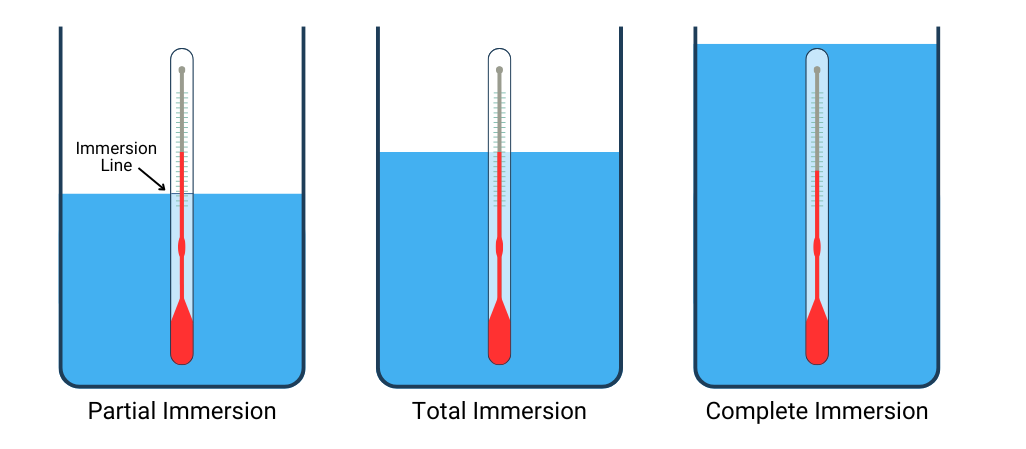
There are three types of immersion in glass thermometers: Partial, total, and complete. As the names imply, they differ based on the depth of immersion required.
Partial
Partial immersion thermometers feature a line on the back of the instrument, called the immersion line. This line indicates the immersion depth required for an accurate temperature reading.
They are fantastic for shallow liquids, such as a low-level water bath or a beaker on a hot plate. Additionally, they are easy to purchase online and reasonably available.
However, since a portion of the thermometer's stem, called the emergent stem, is unsubmerged, temperatures may not be as precise. Therefore, they are not recommended for highly sensitive applications that require exact temperature readings. Nonetheless, these thermometers are reliable for general-use applications.
| Type | Ideal Depth | Availability | Accuracy | Intended Use |
|---|---|---|---|---|
| Partial Immersion | Shallow | Very Available | Not Fully Accurate | General-Use Lab Applications |
Total
Total immersion does not imply a complete immersion for accurate temperature readings. Accuracy is maintained by submerging the thermometer within 1 cm of the top of the spirit/mercury column. As the levels change, it may need to be adjusted accordingly.
For instance, if the liquid in a thermometer column measures a temperature of 50°C, it should be immersed within 1 cm of the 50°C mark of the main scale. With this in mind, total immersion thermometers may require deeper liquids to submerge in for accurate readings.
Despite the depth drawbacks, they are easily accessible for purchase and are highly accurate compared to partial immersion, making them perfect for precise applications.
| Type | Ideal Depth | Availability | Accuracy | Intended Use |
|---|---|---|---|---|
| Total Immersion | Fairly Deep Liquids | Very Available | Highly Accurate | Applications Requiring Highly Accurate Temperatures |
Complete
Complete immersion thermometers provide accurate temperature readings when fully submerged in the substance, including the stem. This requires relatively deep liquids and is not as readily available for purchase in the USA.
However, they are considered to be highly reliable for temperature-sensitive applications.
| Type | Ideal Depth | Availability | Accuracy | Intended Use |
|---|---|---|---|---|
| Complete Immersion | Deep Liquids | Difficult to Find | Highly Accurate | Applications Requiring Highly Accurate Temperatures with Deep Liquids |
Can They Be Used Interchangeably?
No, these thermometers cannot be used interchangeably. Each type is calibrated for its specific type of immersion, and failure to use them properly will result in inaccurate temperature readings as much as 5°C or more, especially as temperatures increase above ambient temperatures.
When selecting a thermometer for immersion applications, consider the depth of the liquid being measured, the required accuracy, the intended use, and the availability. Need additional insight to decide on which thermometer type is best for you? Read our article Which to Choose: Mercury Thermometer vs. Spirit Thermometer to learn more. You can also contact our expert team for any assistance at 1-800-733-2522, [email protected], or message us via Live Chat, available on our website.
Sources:
https://www.belart.com/labguy/partial-total-immersion/
https://www.chem.purdue.edu/chemsafety/chem/HgFAQ.html
https://icllabs.com/total-immersion-partial-immersion-what-do-these-terms-mean/