

Burette Types and the Titration Process Explained
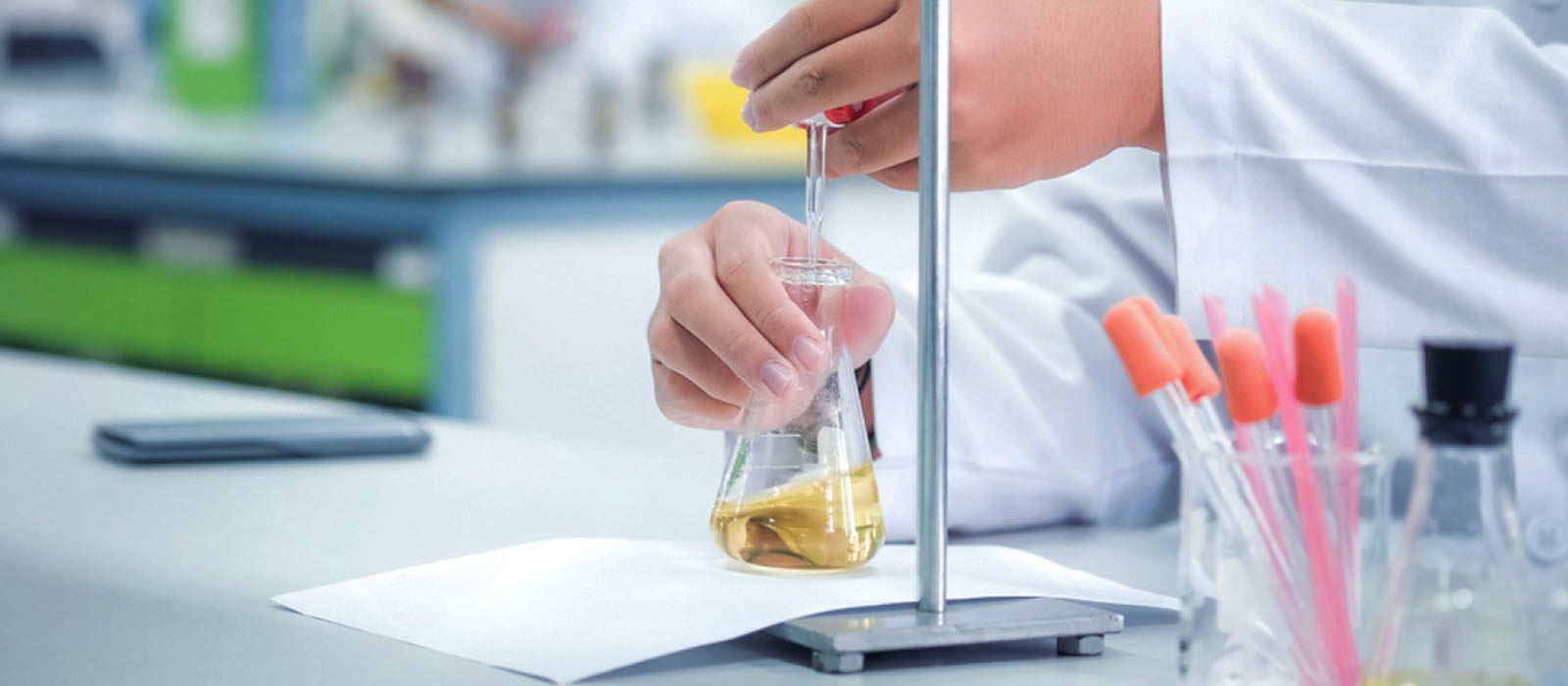
Explore the essential parts of a burette or buret and the different types you can use to perform a proper titration in the lab.
A titration tube is officially known in laboratory settings as a burette. It is a long, graduated tube made of glass or plastic, equipped with a stopcock valve at its lower end.
Its main purpose is to dispense incremental and measurable volumes of the titrant. It has an excellent structural capacity for uniform liquid delivery, making it essential for performing volumetric analysis to find out the unknown concentration of a substance.
The Lab Depot carries various kinds of burettes from Corning Life Sciences, United Scientific, and other trusted brands. These burettes are available in different materials, with capacities ranging from 5 mL to 250 mL.
What Makes Up a Standard Burette?
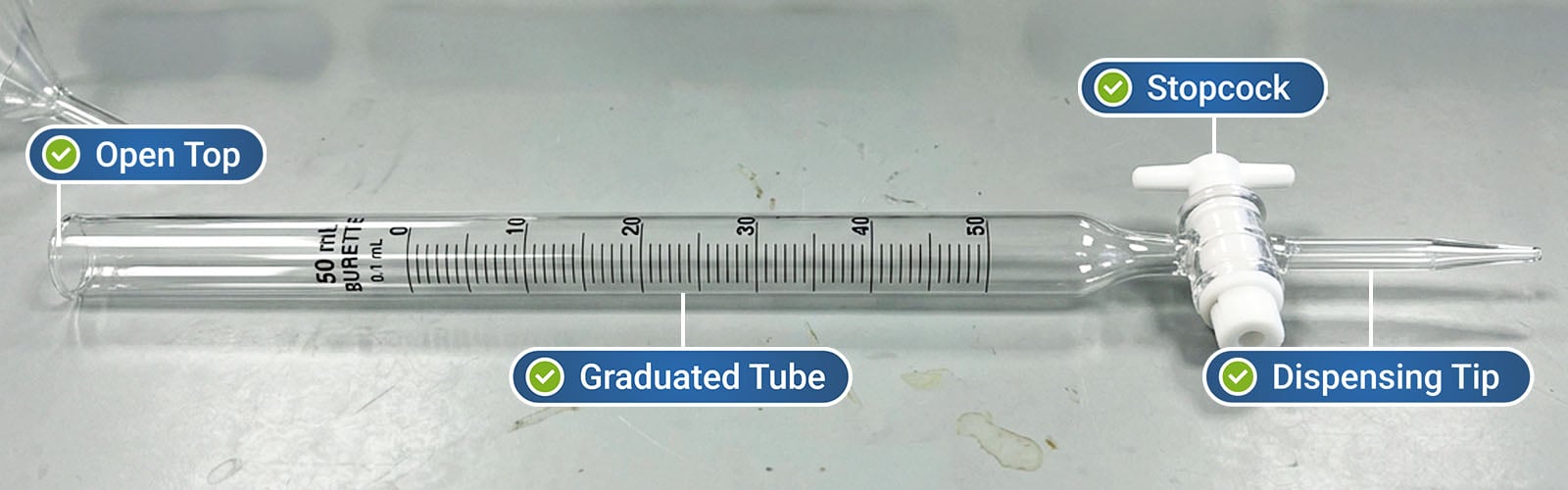
A glass or plastic burette consists of four key parts:
-
Graduated Tube: A long, straight, cylindrical tube with a uniform diameter. Its outer wall shows engraved or printed graduated marks, ranging from 0 at the top to the maximum capacity of 25 mL or 50 mL at the bottom.
-
Stopcock: An adjustable valve for regulating the flow of liquid. It is usually made of polytetrafluoroethylene (PTFE) and located at the base of the tube, just above the dispensing tip.
-
Dispensing Tip: This capillary tube delivers the liquid in fine, precise droplets. It features a tapered, narrow opening design to minimize the volume of liquid it dispenses.
-
Open Top: This is the top opening where the titrant is poured in, using a small funnel to prevent spills. It is left open during operation so gravity can naturally pull the liquid downward when the stopcock is opened.
5 Types of Burettes
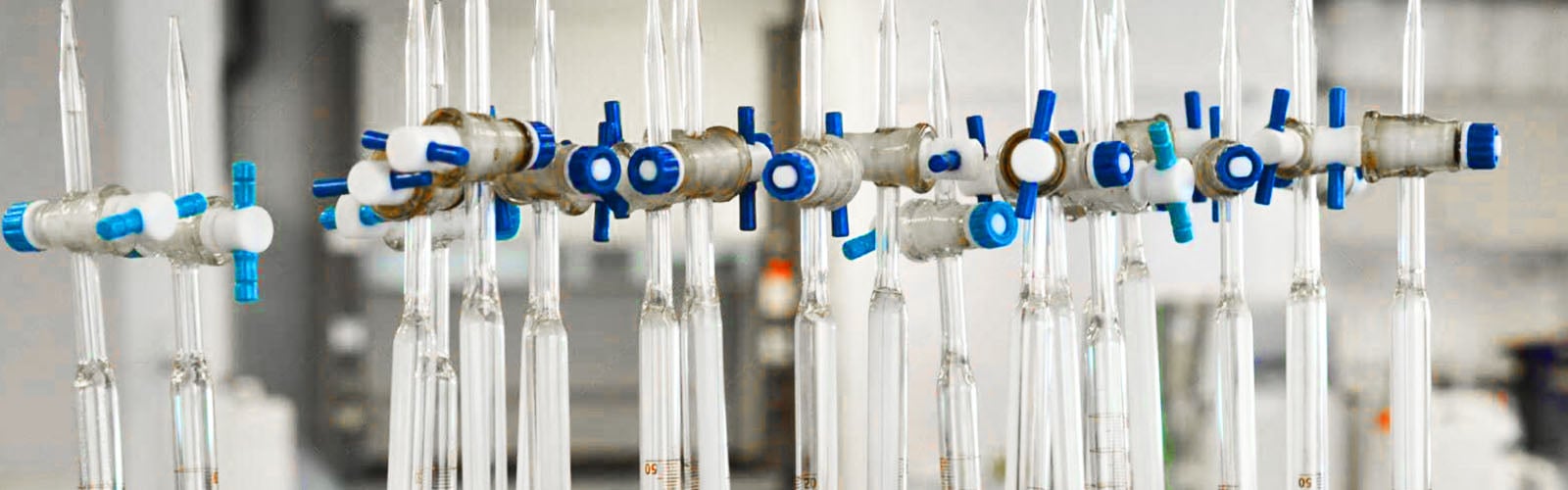
Burettes come in several configurations depending on the level of automation and the physical states of the chemical being measured.
-
Volumetric Burette: A standard glass burette used in most educational and analytical laboratories. It relies on gravity and manual manipulation of the stopcock to dispense liquid.
-
Digital Burette: An electronic burette that uses a mechanically driven piston inside a calibrated syringe cylinder to displace fluid. It has a digital display that shows the exact volume dispensed.
-
Gas Burette: A unique burette where the stopcock is placed at the top of the graduated tube. Water or mercury fills the tube, and gas is introduced to displace the fluid, allowing you to measure the volume of gas generated or consumed during a reaction.
-
Chamber Burette: A chamber or bulb burette features an enlarged bulb in its upper section. This design allows for highly accurate readings within a smaller, targeted volume.
-
Weight Burette: A special type of burette that measures the mass of the delivered titrant rather than its volume. It eliminates errors caused by liquid contraction or thermal expansion.
What is a Titration Test?

A titration test is the analytical chemistry method used to calculate the concentration of a dissolved substance. The main objective of any titration test is to monitor a chemical reaction between the analyte and the titrant. By testing how much titrant is required to completely react with the analyte, lab technicians can use stoichiometry to calculate the exact chemical makeup of the sample.
Types of Titration Tests
-
Acid-Base Titration: Runs a simple neutralization reaction between an acid and a base (or vice versa) to measure an unknown concentration.
-
Redox Titration: Measures how electrons shift between the sample and the solution in the burette.
-
Complexometric Titration: Relies on the formation of a metal-ion complex between the analyte and a complexing agent, most commonly EDTA.
-
Precipitation Titration: Involves a reaction where the added titrant combines with the analyte to create an insoluble compound.
How Does Titration Work?
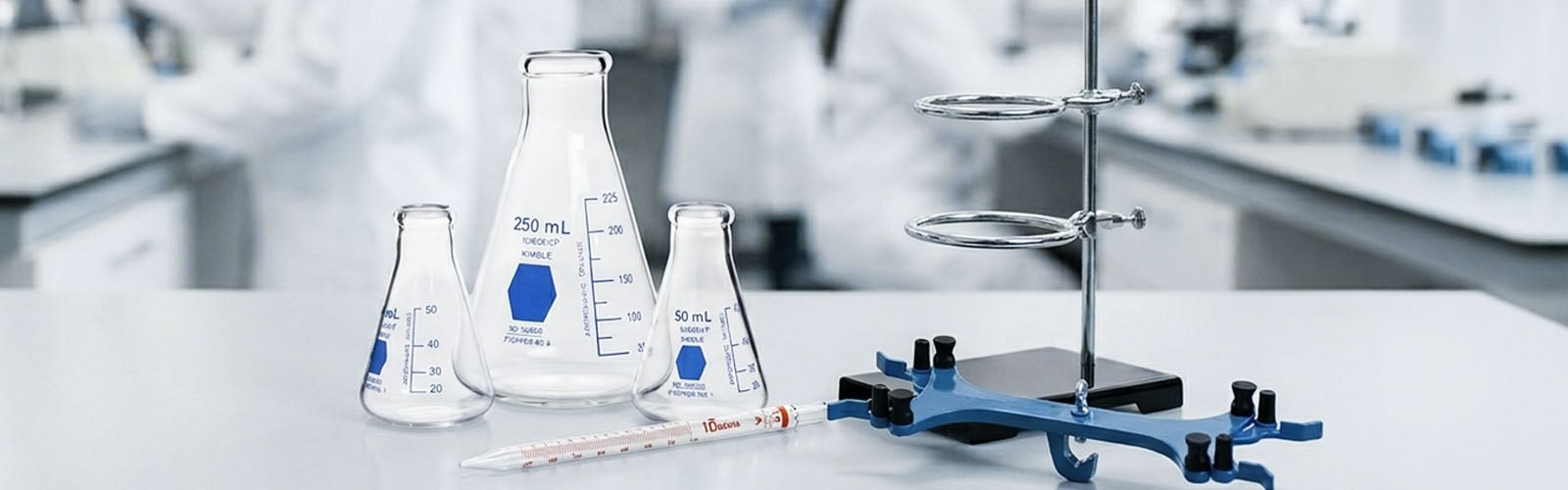
Titration determines the unknown strength of the analyte through these steps:
Step #1: All the necessary instruments for a standard titration are set up. This process requires a burette, a ring stand, clamps, an Erlenmeyer flask, and a pipet.
Step #2: The burette is filled with the titrant, a solution of a known concentration. A flask containing the analyte is placed directly underneath the burette tip.
Step #3: The stopcock is slowly opened to add the titrant drop by drop into the flask while continuously swirling the mixture.
Step #4: The titrant is added until the reaction reaches its equivalence point or the exact moment where the two chemicals completely neutralize or react with each other.
Step #5: A chemical or pH indicator changes color permanently at the endpoint. Added to the flask beforehand, it signals that the stopcock should be closed.
Step #6: The starting and ending liquid levels on the burette's marked glass are compared to find the exact volume of the titrant used. The measurement determines the analyte's concentration.
Find different types of burettes from industry-leading manufacturers at The Lab Depot! If you need help choosing or have questions, contact our expert team at 1-800-733-2522, email, or through live chat on our website.